
Glimpses of the Untold History of the Indian Freedom Struggle - Part 11
मराठी हिंदी ગુજરાતી বাংলা తెలుగు മലയാളം ಕನ್ನಡ தமிழ்
With every passing day Gangadharrao’s health was failing and so he adopted ‘Damodarrao’, the young son of his cousin. Within a few days of the adoption ceremony, Gangadharrao breathed his last. Swallowing her grief, Rani Laxmibai took up the reins of the state. Within a mere fifteen days she had set about her duties of governance with her little son on her lap.
Governing skills came to Rani Laxmibai very easily thanks to her education and special training over the previous five years not to mention her practical life experiences, which were an added advantage. So, under her rule, for the very first time, the subjects saw the rise of happiness and prosperity.
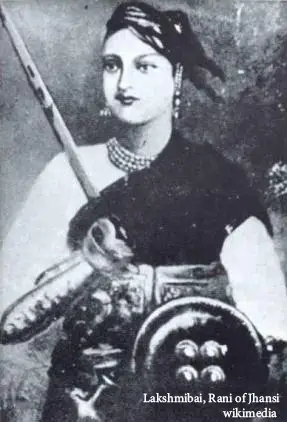
The blessings of the commoners, their appreciation and praise that the Rani of Jhansi was showered with, were not to escape the watchful eye of the British officer posted in Jhansi and he forwarded a complaint to that effect to his superiors. However, the special intelligence reports received by the superiors from his own sources stated that Rani Laxmibai was found immersed in worship, chanting the name of God and visiting temples both in the morning and in the evening. She happened to meet common women citizens very often and offered help in charity to the needy, the poor, the orphans and the handicapped which was the reason why she received all the blessings. But in any case, Rani Laxmibai was totally loyal to the British Government. The intelligence officer who supplied this information was none other than Diwan Raghunathsingh
The British officers, who were at ease and laid-back due to this information were in for a rude shock when the evidence gathered at the site of Dhansinh Gurjar’s hideouts came to the forefront. It was then that they learnt that Rani Laxmibai of Jhansi had been providing funds to Dhansinh Gurjar and that fifty of Jhansi’s citizens were part of Dhansinh Gurjar’s group!
Shaken to his senses, the British governor conveyed the news to the British Viceroy. (The post of ‘Viceroy’ was not in effect until then. It was the head of the British administration, i.e. the Governor General, who was considered the Viceroy.)
The information immediately galvanized the high-ranking officers of the military into action. In the wake of the powerful fight put up by Dhansinh Gurjar the East India Company Government instituted a total of 34000 laws following his martyrdom. The laws, a result of meticulous deliberation, were rigidly and rigorously implemented.
The princely state of Jhansi received a letter from the British administrative top brass that the Company government did not recognize the adoption by the late king of Jhansi. The letter further demanded that the administration of Jhansi co-operate as was expected of it, officially furnish all required information and prepare to hand over the reins of the state to the Company Government.
Rani Laxmibai and her principle followers had seen this coming. All they had wondered about was ‘the pretext’ under which the British planned to execute the demand. The refusal to recognize the adoption pointed to a scornful disregard for the religious beliefs of the Hindu Vedic religion. The Rani of Jhansi was seething with rage. She saw through the ruse. She knew that it was a treacherously designed assault launched blatantly on the Vedic dharma, on the power of the Indian princely states as well as on the lifestyle or norms followed by the Bharatiya commoner.
With Diwan Raghunathsinh’s help the Rani began corresponding with top-ranking British officers. Lalabhau Bakshi was sent as the envoy, the strategic motive being, to buy time and gain space. Moreover, alongside these moves, Rani Laxmibai began spending more and more of her time in temples. She began organizing different kinds of Mahapooja in various villages. Sessions of recitation of Vedic verses and of accounts from the Puranas too became widespread.
Under the guise of temple visits, Mahapoojas and the sessions of recitation, Rani Laxmibai and her trusted aides systematically began educating the general public on the actual evil intentions of the British. At the same time funds contributed by people who swore staunch loyalty to their dharma and whose heart beat with national pride were pooled and Puransinh and Khuda Baksh secretly began to buy weaponry.
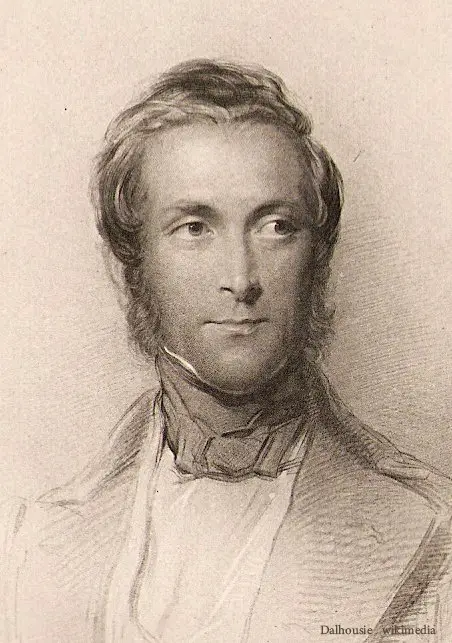
On 14th May 1857 Governor General Lord Dalhousie handed over to the Rani of Jhansi, an official decree: the adoption rite was illegal and the state of Jhansi had been annexed to the British crown. That very night, the Bharatiya soldiers stationed in the Jhansi cantonment launched coordinated attacks in the entire city. Battling the British officers, they succeeded in slaying them. Not a single one of the British officers survived the incursion.
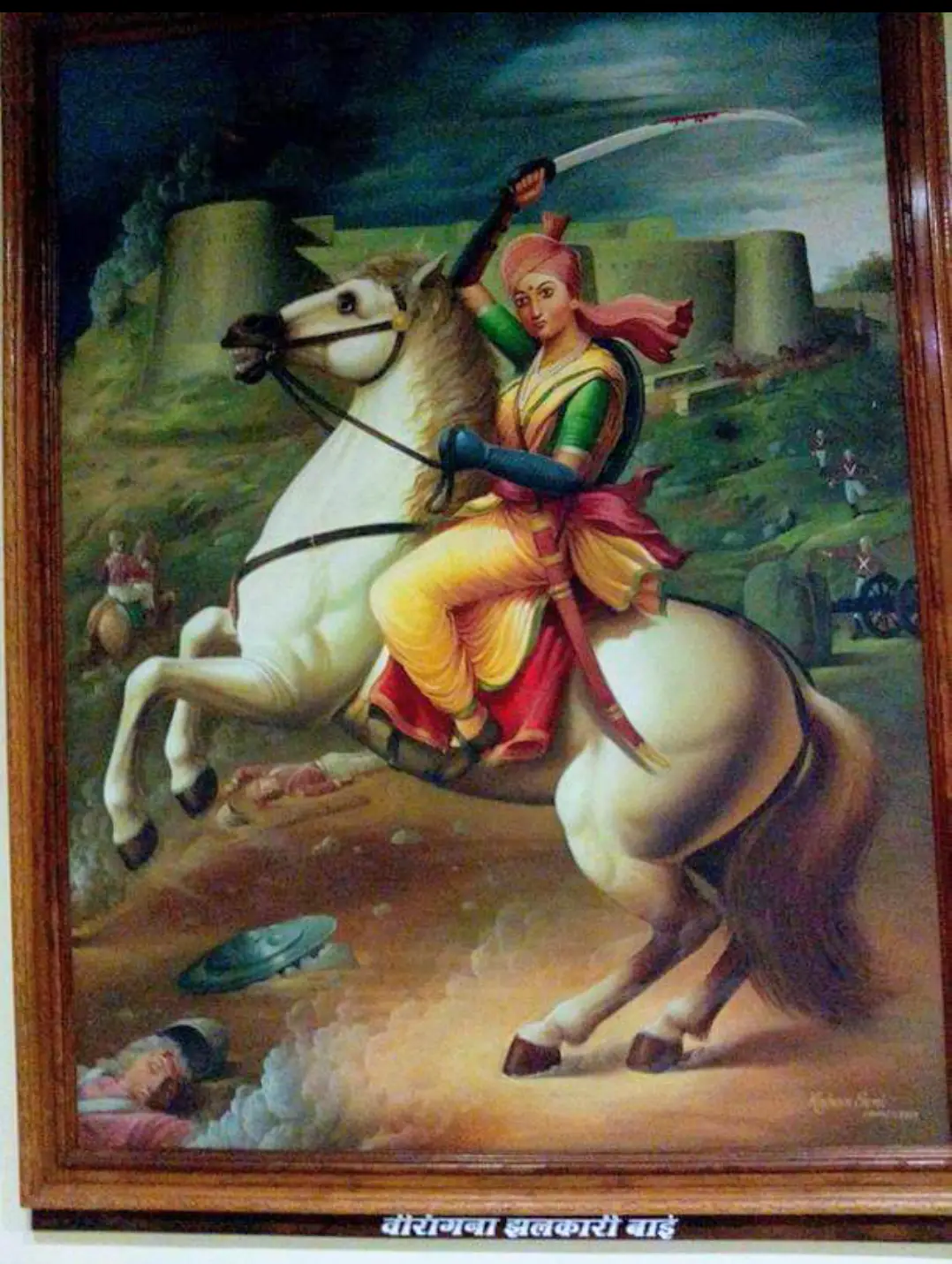
Rani Laxmibai convinced Major General Hugh Rose that the incidents of violence were but a ‘seepoy mutiny’ and simultaneously ensured that negotiations continued. Though Major Hugh Rose was camped in Jhansi through November and December of 1857 neither he, nor his officers nor even his spy network had been able to get so much as a whiff of Rani Laxmibai’s secret activity. The credit was due to Rani Laxmibai’s own astute diplomacy apart from of course, the remarkably visionary planning of her trusted aides. A team of nine, consisting of Diwan Raghunath Sinh, Lalabhau Bakshi, Khuda Baksh, Puransinh Kori, Jhalkaribai, Motibai, Sundar Begum, Kamal Kumari Chauhan and Rajkunwar Yadav worked in calm poise and diligence executing every task under the command of Rani Laxmibai. The Durga-Dal and the MahadevShiv-Dal were steadily expanding their reach. Major General Hugh Rose headed out of Jhansi to meet with his superiors, viz. Lord Dalhousie. He was as yet on the second lap of the journey when traitors from the states around Jhansi approached him, evidently with a purpose. They were those who had been nursing jealousy in their hearts, jealousy of the dazzling valour and of the excellent governance of the Rani of Jhansi. They reported to Hugh in detail about the movements and activities of the Rani of Jhansi and even presented evidence in support of their statements.
This changed the scenario around and certainly for the worse. Major Hugh Rose, who had set out to speak to Lord Dalhousie in favour of the Rani of Jhansi, went all out to bitterly oppose her. That he had no clue about the actual activities of Rani Laxmibai despite camping in Jhansi for two whole months, had left him with a dent in his ego. He was determined to teach the Rani a lesson and completely obliterate the kingdom of Jhansi.
By this time Rani Laxmibai had already established contact with Nanasaheb Peshwa who was preparing to fight the British. In fact Tatya Tope, the chief representative of the Peshwas had already visited and stayed in Jhansi twice. In case of an attack, it was decided that along with his force of three thousand soldiers, Tatya Tope would rush to the Rani’s aid.
Following Lord Dalhousie’s orders, on 15th March 1858, Major General Hugh Rose attacked Jhansi with an army of ten thousand soldiers. A fierce battle ensued.
Major Erskine was the commander in chief. While the battle continued, Lalbhau Bakshi and Diwan Raghunathsinh did not give up talks with Major Erskine. Rani Laxmibai was certainly not incautious or unwatchful. 3500 brave women warriors of the Durga-Dal charged directly at Major Erskine’s cantonment and attacked them. Rani Laxmibai and Jhalkaribai had charged at the cantonment and closed in from two different directions;
and the Durga-Dal returned, but not before it had slain 4000 British soldiers.
…to be continued