Glimpses of the Untold History of the Indian Freedom Struggle - Part 13
मराठी हिंदी ગુજરાતી বাংলা తెలుగు മലയാളം ಕನ್ನಡ தமிழ்
Steeling themselves for the impending attacks that the British were soon to launch, the Durga Dal and the Mahadev-Shiv Dal, Rani Laxmibai’s specially trained battalions braced themselves up for the challenging times. Their courage as indomitable as their nerves, they unleashed fierce counter offensive attacks. As Rani Laxmibai battled from within the Jhansi Fort, hundreds of her soldiers hiding until then in various parts of the city of Jhansi and in other parts of the state emerged from their hiding and began ambushing Major Erskine’s army in co-ordinated attacks unleashed from multiple spots.
‘The British army has lost fifteen hundred soldiers in the first four days itself whereas we have been able to claim the lives of not more than two or may be four from the Rani’s army’, so stated the report that the intelligence officers of Major General Hugh Rose sent to him along with Lord Dalhousie bypassing Erskine. This led to the British troops gathering on the outskirts of Jhansi.
After a discussion with her close aides, Rani Laxmibai headed towards the ‘DevGruha’ (the room where idols of Gods are kept, worship and prayers are offered). Attacks on Jhansi were escalating. Every day after the first four days brought news of colossal loss – in terms of lives of the soldiers and in terms of resources of the state of Jhansi.
Laxmibai’s army that had harassed the British army both outside the fort and through their guerrilla tactics, was now cut down to half its size. 50% of the soldiers had fallen in war. Thoughts weighing heavy on her mind, Rani Laxmibai walked towards the DevGruha. Should she order the troops engaged in guerrilla warfare outside the fort to put down their arms or should she allow them to continue fighting? How was she to communicate the orders to them in any case? The British had demolished all the seven tunnels leading from the fort to the surrounding areas making it impossible for her to send out any communication.
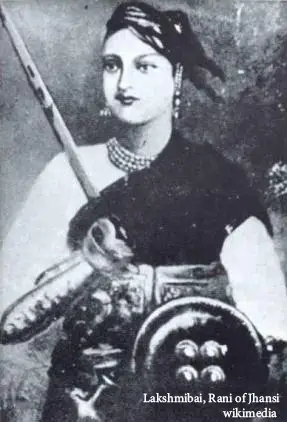
Rani Laxmibai entered the DevGruha, took darshan and lit a lamp. ‘This could very likely be our last meeting’, she told the Gods in clear words. Not turning around once, she walked out of the DevGruha, determined and resolute. The Devgruha housed Gods of course but also large portraits of her husband, her son and her late mother. These life-like works that were an exact likeness of their respective subjects were made by Puran Singh Kori. She refused to shed a single tear. As she crossed the threshold of the DevGruha, this Bharatiya woman, loyal and committed to her husband in word and deed, recalled him to her mind and said to him, “We might perhaps meet soon. I will of course be happy to meet you both, But Jhansi was your mother. Do pray to God for her protection.”
The DevGruha behind her now, Rani Laxmibai made her way towards the second storey of the fortress where Puran Singh Kori and Raghunath Singh awaited her with some very important news.
All alone, she walked along the expansive corridor. There was not a single servant in the entire fortress. All the servants, cooks and even water-bearers were engaged in war in one way or the other. The soldiers often had no time for meals. It was then that the cooks and the water-bearers stepped in, lovingly fed the soldiers and gave them water to drink and the soldiers ate the morsels they were fed, their hands still engaged in their weapon. None of the troops had been able to sleep more than two or three hours.
Deep in thought, Rani Laxmibai walked on. Always with her like a shadow, Mundar Begum, her personal bodyguard walked close behind, her eyes locked on Rani Laxmibai.
All of a sudden, a person dressed in military attire appeared out of nowhere stood before Rani Laxmibai. Despite the pitch darkness, Mundar Begum recognized the uniform that was unmistakably British. In the blink of an eye, the tigress that she was, she lunged forward to catch the British soldier. About to fall, the soldier dropped the Seepoy hat on his head alerting Mundar Begum. Startled, she gasped, “Oh Jhalkari!! Is that you?”
“Yes, it is me, Jhalkaribai”. The three of them scurried to the nearest room. Taking Jhalkari’s hand in her own, with love and respect, Rani Laxmibai sat her close to herself. “Dear sister Jhalkari! What exactly do you intend to achieve clad in this outfit? You have so many bruises! Also, considering that we have not a single tunnel left, what did you manage to do and where have you come from?”
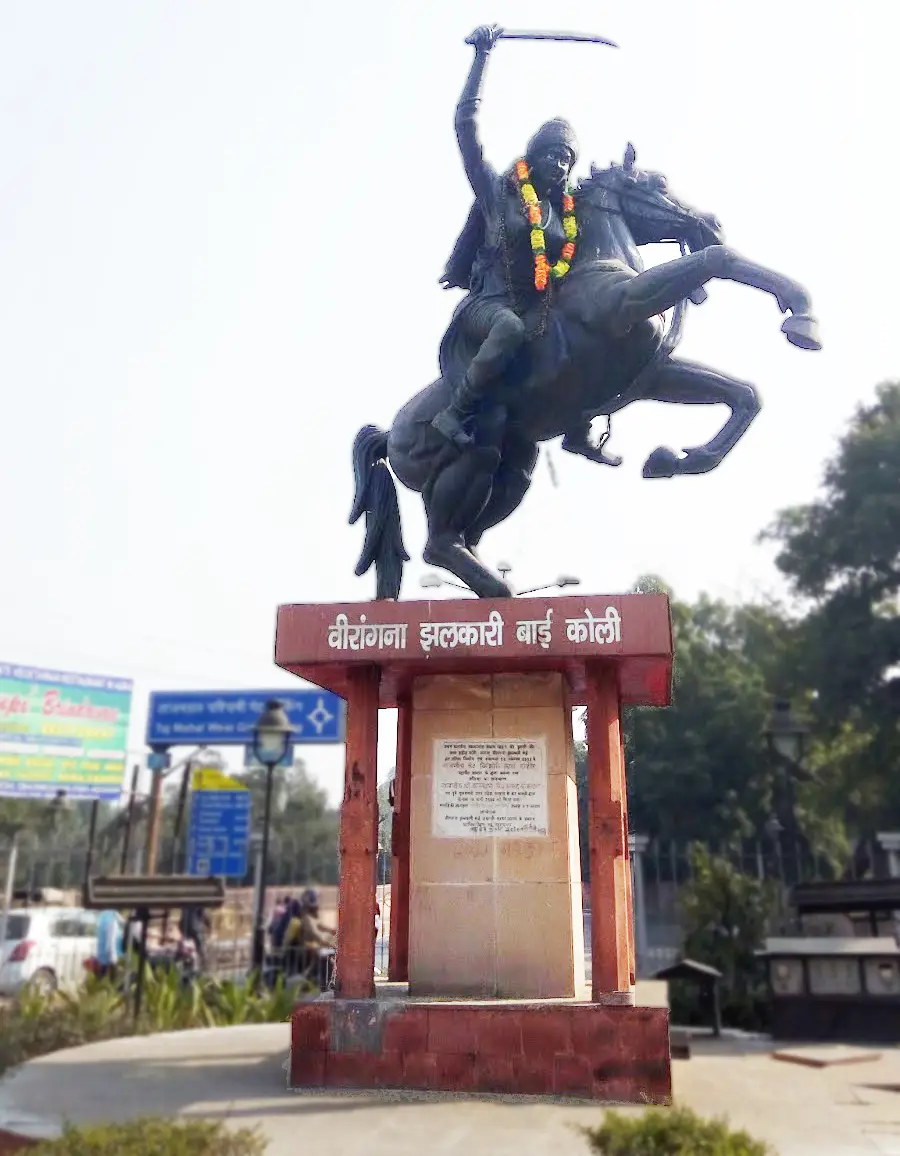
Calm and collected, Jhalkaribai offered her salute to Laxmibai and said, “As we know, the northern cliffs of the fort of Jhansi are impassable and so we did not forge any tunnel there. Besides, there is no path as such for descent from the sheer cliff.
But yesterday I observed a cat go down the cliffside. Going down the same path, tonight I could reach the base of the fort. The British troops do not patrol the spot because of the jumble of jagged boulders. But you should, for sure be able to find your way down the cliff.
I earnestly request you to pick a few loyal soldiers and taking to this secret route, descend the fort and head for Kaalpi. I do not think we can hold this fort more than three days. If you survive, the fight can continue or else Tatya Tope too will be isolated and killed. Just think. On the borders of Kawnpoor (called Kanpur today) the British have even intercepted the troops that Tatya Tope meant to send. However, if you launch attacks from the outside, you will facilitate Tatya Tope’s defense from inside Kawnpoor. You have to leave. That is the best option.”
“I will not flee!” declared Rani Laxmibai, firm and resolute. Raghunath Singh, who was approaching her hurriedly, replied with equal resolve, “I am your father’s age. That does not amount to fleeing, that is actually strategy and that happens to be the only ray of hope, the only way leading to victory.”
“Why do you say so?” asked Rani Laxmibai. Diwan Raghunath Singh and Naik Puran Singh replied in one voice, “Dulherao, one of our commanders has defected. Taking with him his entire unit, he has joined the British. He knows this fort like the back of his palm and he has all details of our forces. This deceitful traitor is bound to pass on all the information to the British. Hugh Rose, the British Major General has offered him a huge estate. It is indeed advisable to leave. We have no time to ponder.”
It was decided that Rani Laxmibai should descend the fort in the dead of the night. Lalbhau Baksjhi, Motibai, Khudabaksh and Mundar Begum accompanied her. Rani Laxmibai began the dangerous descent scaling down the sheer cliff.
And exactly at that time, dressed as Rani Laxmibai, Jhalkari led two hundred soldiers down the fort braving the British. She had just the one purpose: She had to engage the British army and attention in fighting her allowing Rani Laxmibai enough time to reach Kalpi safely and without any obstructions.
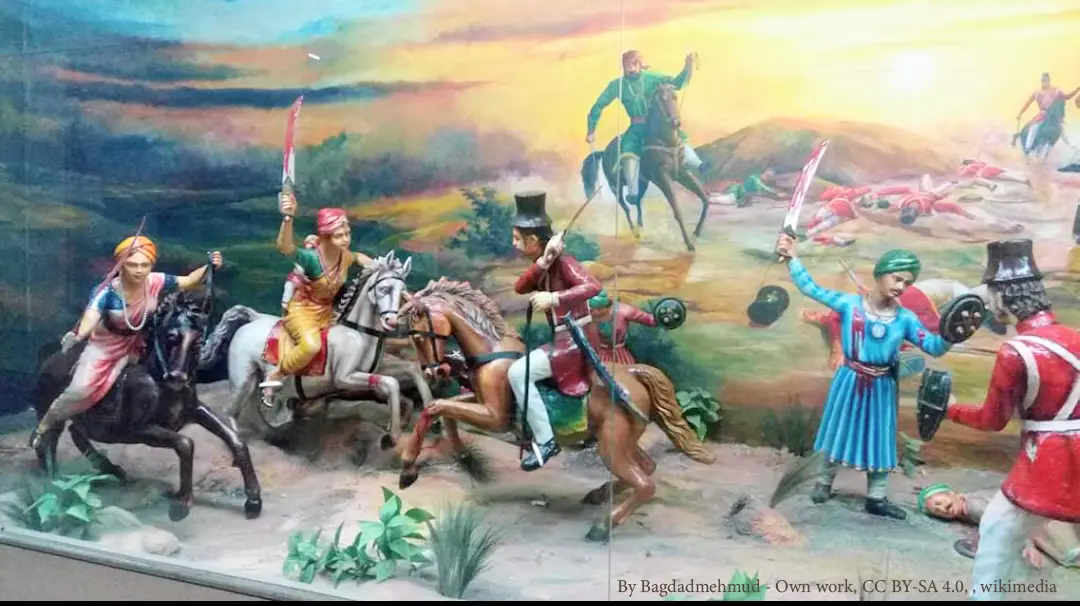
Noticing Jhalkaribai descending the fort fighting, Hugh Rose was delighted. He ordered his troops to soften the assault. He wanted to capture Rani Laxmibai alive. The night of 3rd April 1858 was a night of carnage. Her husband Puran Singh Kori fell to a bullet right before Jhalkaribai’s eyes. She offered her namaskar to her martyred husband and smearing her forehead with his blood, Jhalkaribai reached the British camp. For the next twenty-four hours, she kept fighting the enemy around their own camp. Finally it was just Jhalkaribai and her two aides: Raj Kunwar and Kamal Kumari left on the battle field.
The night of April 4th fell. Her left arm riddled with bullets, mangled and incapacitated, Jhalkaribai tore into the cantonment, riding her horse. Kamal Kumari had already conveyed the message that Rani laxmibai had reached Gwalior.
Her left arm hung from the shoulder. Jhalkaribai roared, her zeal and ferociousness matching that of Rani Laxmibai. She now headed directly for Major General Hugh’s tent and unleashed her assault.
She ordered her companions to quietly turn around. All alone, she kept advancing.
At the stroke of midnight of April 4th, Jhalkaribai spurred her horse right in front of General Hugh and her blade struck his shoulder. Within a fraction of a second, several British soldiers charged at her and attacked her. Jhalkaribai uttered her last words, “I am just Jhalkari. The sun, the actual sun Laxmibai is still inside the fort, preparing for her strike.”
Jhalkaribai’s eyes were heavy. As the light left her eyes, all she could see was Laxmibai’s face. She breathed her last but not before she had broken the steel blade of Major General Hugh’s sword.
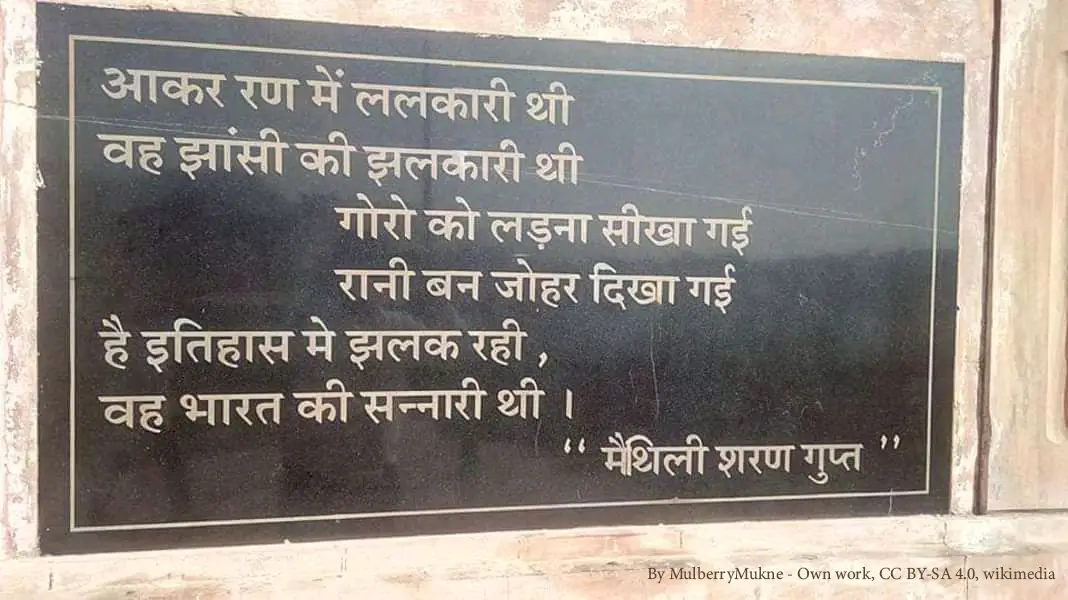
Etched on her memorial, the following words by Maithili Sharan Gupta immortalize her valour, her sacrifice and of course her patriotic pride:
आकर रण में ललकारी थी
वह झांसी की झलकारी थी
गोरो को लड़ना सीखा गई
रानी बन जोहर दिखा गई
है इतिहास मे झलक रही,
वह भारत की सन्नारी थी।
- “मैथिली शरण गुप्त”
( Entering the field she roared fierce,
Jhalkaribai of Jhansi she was,
She taught the British the prowess of war
Her role of the Rani, her valour we saw
On the pages of history she shines bright,
The woman of virtue, Bharat’s pride.
- Maithili Sharan Gupta)