
Glimpses of the Untold History of the Indian Freedom Struggle - Part 30
मराठी हिंदी ગુજરાતી বাংলা తెలుగు ಕನ್ನಡ தமிழ்
Lokmanya Tilak, through his newspaper Kesari, openly praised the martyrdom of Khudiram Bose and convinced the people that the attack on the women had occurred because of a mistaken carriage. Not stopping there, Tilak also began to argue that British atrocities—through figures like Commissioner Rand (the Plague Case) and Chief Magistrate Douglas Kingsford (the Sushil Sen Case) would only continue to escalate and therefore he asserted that Indians must immediately fight for Swaraj, that is, Self Rule, using every possible means. Translations of Tilak's writings in the form of pamphlets and leaflets began to be distributed across every province in India.
Several Indian princely rulers adopted policies even stricter than those of the British, prohibiting Tilak’s newspapers or pamphlets containing his writings from entering their states. However, their subjects gradually began to turn against them, forcing these rulers to withdraw their opposition to Tilak’s publications.
As a result of these developments, the British government in India became determined to eliminate Tilak. Numerous secret plans were made to destroy him. Yet, some members of the Labour Party in the British Parliament strongly opposed these moves, warning that “if such secret actions came to light, the British would not be able to remain in India even for a single day.”
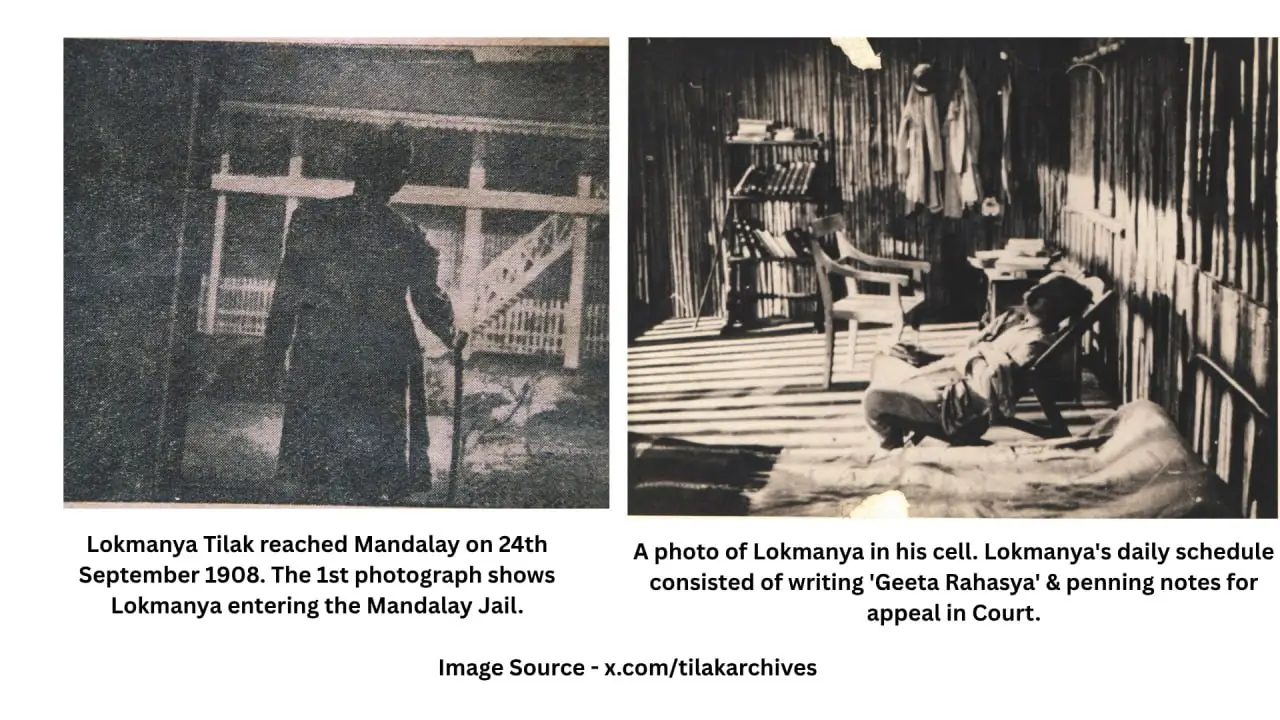
Eventually, a case of sedition was filed against Tilak, and he was sentenced to six years of rigorous imprisonment — in the notorious ‘Mandalay’ prison of Burma (now Myanmar). In this case, Mohammad Ali Jinnah served as Tilak’s chief lawyer. Jinnah worked tirelessly, day and night, to defend Tilak. (This same secular and truly patriotic Jinnah later turned against India and became the founder of Pakistan, due to the extremely misguided decisions of Gandhi and Jawaharlal Nehru.)
After the sentence was announced, Justice Dinshaw Davor asked Tilak for his final statement. Lokmanya Tilak thundered in open court:
“I have only this to say — whatever the jury’s verdict may be, I am innocent. The true power in this world belongs to the Divine Force, and it is God who ordains everything. It may be the will of the Omnipotent Providence that my sufferings in prison should have an even greater effect and influence than my speeches and writings.”
Across India, marches, processions, public meetings, discussions, lectures, and patriotic gatherings continued for many days in support of Lokmanya Tilak and in opposition to British rule.
The British took Tilak to Mandalay in Burma and subjected the fifty-two-year-old man, already advancing in age, to immense torture. Every day he was forced to twist coir fibers and make ropes, mats, and sacks from them.
The food given to him was also of the poorest quality, and sweets were deliberately served to him. He was denied ordinary meals because Tilak had early diabetes. His medicines were stopped, and as he was being fed only sweets, it caused his diabetes to worsen day by day.
He was denied every kind of concession. Gandhi and Jawaharlal Nehru, when imprisoned by the British, were often kept with attendants and without being made to work, in luxurious places such as Aga Khan Palace.
Thus, when Tilak was released on 16 June 1914 after serving the full six-year sentence, his health had greatly deteriorated. Every step had become difficult for him. Yet even in such a condition, Tilak did not reduce the pace of his tours in the slightest and once again launched fierce attacks on British rule through his writings.
Lokmanya Tilak observed the intrigues of the soft-liner leaders of the Indian National Congress and, weary of their conduct, founded the Home Rule League with the cooperation of Annie Besant.
Annie Besant was born in London on 1 October 1847. Her maiden name was Annie Wood. Her mother was of Irish origin, and the Irish people were themselves struggling against the British Government for an independent Ireland.
Annie Besant was a resolute supporter of both Irish and Indian freedom. She too came to India and began fighting against British rule.
In 1902, Annie Besant described British rule in India in extremely harsh words: “The claim that the British govern India for her progress and development is the height of falsehood. India is being used merely as a source of enormous profit, and the sons of the land are being used like slaves.”
When the First World War began in 1914, the British started recruiting soldiers from India. At that time, after making secret contact with Tilak, Annie Besant, as editor of ‘New India,’ declared boldly: “England’s need is India’s opportunity.”
After Tilak was again imprisoned after 1914, Annie Besant continued the work of the Home Rule League energetically. The Home Rule League was formally established on 28 April 1916. Dr. Besant used to mostly wear Indian attire.
While being imprisoned in Mandalay, Lokmanya Tilak wrote the magnificent book ‘Gita Rahasya,’ a profound exposition on the Bhagavad Gita. Though his own hands were wounded from twisting coir fibers, and swollen with pain, Tilak still wrote such a great work while holding the pen in those injured and swollen hands. This book began to inspire all of India with the fiery teaching of Karma Yoga.
As soon as he came out of prison, Lokmanya Tilak began touring the whole of India relentlessly. He traveled through hundreds of small towns and thousands of villages, nearly ninety thousand in alland held public meetings everywhere.
Tilak was the first leader during the freedom struggle to awaken the masses living in Indian villages. Even in remote villages with populations of barely five hundred, thousands would gather to attend Tilak’s meetings.
Tilak’s stormy tours and fiery writings began to shake British rule severely. He bluntly advised Mahatma Gandhi to refrain from excessively promoting non-violence. However, even after five meetings, Gandhi clearly refused to listen to Tilak and instead began strengthening the soft-liner faction within Congress.
Tilak was once again imprisoned in 1916 for one and a half years. Even after his release, his work continued.
But on 1 August 1920, he passed away after a one-day illness at Sardar Griha, a hotel in Mumbai.
For every Indian, this was a tremendous shock. People across the nation became convinced that the British had poisoned Tilak. Only God knows, what the truth was.
(The story continues.........)